10 Questions to Ask Before Choosing an OEM Tungsten Dart Manufacturer
Launching a new tungsten dart collection is more complicated than simply selecting a barrel shape and putting a logo on the packaging.
For brands, distributors, sporting-goods companies, and professional dart businesses, the choice of an OEM tungsten dart manufacturer can directly affect product quality, consistency, production costs, delivery schedules, and ultimately customer satisfaction.
A manufacturer may offer an attractive quotation, impressive product photos, or a low minimum order quantity. However, these factors alone do not tell you whether the factory can consistently manufacture the product you have designed.
The real questions are more specific:
Can the manufacturer control tungsten material and density?
Can it reproduce the same barrel dimensions from one production batch to another?
Can it maintain consistent grip characteristics after CNC machining?
Can it handle different surface finishes without changing the feel of the dart?
Can it manage your packaging, accessories, branding, and quality requirements as one integrated OEM project?
And perhaps most importantly, can the manufacturer become a reliable production partner rather than simply a supplier that accepts an order?
Before choosing an OEM tungsten dart factory, buyers should evaluate the manufacturer from the perspective of engineering, production, quality control, communication, and long-term cooperation.
Below are 10 practical questions to ask before making your decision.
- 1. What Tungsten Materials and Alloys Do You Use?
- Why Tungsten Density Matters
- What a Good Manufacturer Should Explain
- 2. Can You Manufacture Custom Barrel Designs From Engineering Drawings?
- Why This Is Important
- Ask About Engineering Review Before Production
- 3. How Do You Control Barrel Weight and Dimensional Tolerances?
- Weight Is Influenced by Multiple Factors
- Dimensional Consistency Matters Too
- 4. What CNC Machining Capabilities Do You Have?
- Why Tooling and Cutting Conditions Matter
- Manufacturing Capability Should Match Your Product Positioning
- 5. How Do You Handle Surface Finishing and Coating?
- Ask About Coating Durability
- Surface Finish Is Also a Product Experience
- 6. Can You Produce Prototypes Before Mass Production?
- What Should Be Checked During Sampling?
- Prototype Approval Should Be Clearly Documented
- 7. What Quality Control Process Do You Use During Mass Production?
- Incoming Material Inspection
- In-Process Inspection
- Finished Product Inspection
- Final Random Inspection
- 8. Can You Handle Complete OEM Packaging and Dart Set Assembly?
- Why Assembly Capability Matters
- Tungsten Dart Sets Can Be Customized
- 9. What Is Your MOQ, Production Lead Time, and Reorder Process?
- MOQ Should Match Your Business Model
- Reorder Consistency Is Critical
- 10. Can You Provide Long-Term OEM Support for Product Development?
- Product Development Requires Communication
- What Should You Look for in an OEM Tungsten Dart Manufacturer?
- 1. Material Knowledge
- 2. Engineering Capability
- 3. CNC Manufacturing Capability
- 4. Quality Control
- 5. Customization
- 6. Production Stability
- 7. Communication
- OEM Tungsten Darts Should Be Evaluated Beyond the Price Per Set
- Questions to Ask During the First OEM Consultation
- Product Information
- Manufacturing Information
- Commercial Information
- How the Right Manufacturer Can Reduce OEM Project Risk
- Design Risk
- Quality Risk
- Cost Risk
- Delivery Risk
- Reorder Risk
- Final Checklist: 10 Questions to Ask Before Choosing Your OEM Manufacturer
- Why OEM Buyers Should Evaluate the Whole Manufacturing Process
- Frequently Asked Questions
- 1. What is an OEM tungsten dart manufacturer?
- 2. What should I provide when requesting a custom tungsten dart quotation?
- 3. What tungsten percentage should I choose for a premium dart?
- 4. How important is the prototype before mass production?
- 5. How can I compare two OEM tungsten dart manufacturers?
1. What Tungsten Materials and Alloys Do You Use?
The first question should be about the material itself.
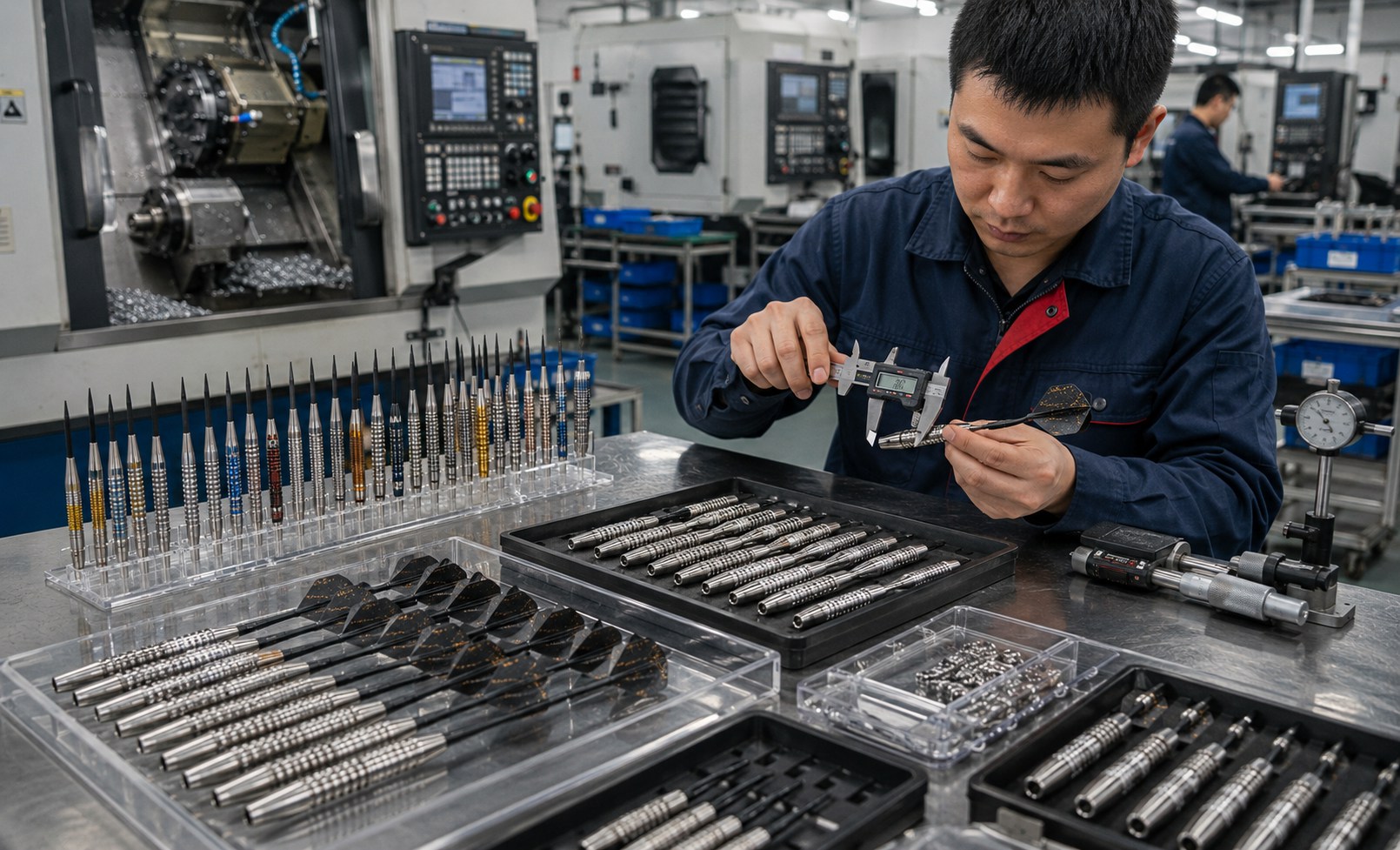
Tungsten darts are commonly manufactured using tungsten alloys because pure tungsten is extremely difficult to machine into the precise shapes required for modern dart barrels. The alloy composition and density influence the final barrel dimensions, weight distribution, machining characteristics, durability, and overall feel.
For an OEM project, simply being told that a dart is "tungsten" is not enough.
You should ask the manufacturer:
- What tungsten alloy is being used?
- What tungsten density options are available?
- Is the material purchased from an established supplier?
- Can the manufacturer provide material specifications?
- Is the same material specification maintained across production batches?
- How does the factory verify incoming material?
Why Tungsten Density Matters
Density is particularly important when designing professional or premium tungsten darts.
A higher-density material allows the manufacturer to achieve a given dart weight using a smaller barrel volume.
For example, two barrels can potentially have the same overall weight while having noticeably different diameters and lengths because of differences in material density and internal design.
This matters because barrel geometry directly influences how a player holds the dart.
A brand developing a premium 90% or 95% tungsten dart may want a relatively slim barrel while maintaining a specific weight. If the manufacturing process cannot consistently control the material specification, the final product may not match the original engineering design.
What a Good Manufacturer Should Explain
A capable OEM tungsten dart manufacturer should be able to explain how the selected tungsten material affects:
- barrel dimensions;
- machining performance;
- weight tolerance;
- surface finishing;
- durability;
- production yield;
- and final product consistency.
The manufacturer does not necessarily need to use one universal material for every project. More importantly, it should understand why a particular material specification is appropriate for your product design.
2. Can You Manufacture Custom Barrel Designs From Engineering Drawings?
If you are developing a private-label or original dart collection, you should not limit your evaluation to a factory's existing catalog.
A serious OEM project often starts with a specific barrel design.
That design may include:
- overall barrel length;
- maximum diameter;
- multiple grip zones;
- rings;
- micro grooves;
- knurling;
- scallops;
- tapered sections;
- nose geometry;
- rear profiles;
- smooth areas;
- and specific transitions between grip patterns.
Ask the manufacturer whether it can manufacture directly from your engineering drawings or technical specifications.
Why This Is Important
A factory may be able to produce standard ring-cut barrels very efficiently but struggle with more complicated geometry.
For example, a design might require three different grip sections along a single barrel:
Front section: fine ring cuts for controlled finger placement.
Middle section: deeper radial cuts for additional grip.
Rear section: smoother machining designed for a rear-grip throwing style.
The design can look simple in a digital drawing but become considerably more complicated during CNC machining.
The manufacturer needs to understand not only the dimensions but also the manufacturing sequence required to reproduce those dimensions consistently.
Ask About Engineering Review Before Production
A strong OEM partner should ideally review your drawings before mass production.
This review can identify potential problems such as:
- excessively narrow grooves;
- machining areas that are difficult to reach;
- overly sharp transitions;
- insufficient material thickness;
- unnecessary machining operations;
- tolerance requirements that increase cost without improving performance;
- or designs that are technically possible but inefficient to manufacture.
This engineering discussion can save significant time later.
Instead of discovering a problem after hundreds or thousands of barrels have been machined, the manufacturer can identify the issue during the prototype stage.
3. How Do You Control Barrel Weight and Dimensional Tolerances?
Weight consistency is one of the most important quality considerations for tungsten darts.
A customer buying a 22 g, 24 g, or 26 g dart expects the product to remain within an appropriate manufacturing tolerance.
For an OEM brand, weight consistency becomes even more important because the same specification may be produced repeatedly over months or years.
Ask the manufacturer:
What weight tolerance can you consistently maintain during mass production?
Do not only ask for the target weight.
Ask how that target is controlled.
Weight Is Influenced by Multiple Factors
The final barrel weight can be affected by:
- tungsten material density;
- raw material dimensions;
- CNC machining depth;
- drilling;
- thread machining;
- polishing;
- surface treatment;
- and production tolerances.
A barrel can therefore meet the basic shape requirement while still producing weight variation if the manufacturing process is not tightly controlled.
Dimensional Consistency Matters Too
Weight is only one part of the equation.
Important barrel dimensions may include:
- overall length;
- maximum diameter;
- grip section diameter;
- thread dimensions;
- groove depth;
- nose angle;
- rear taper;
- and other critical features.
For an OEM project, these dimensions should be controlled against an approved sample or engineering drawing.
A professional manufacturer should have a defined inspection process rather than relying entirely on visual comparison.
4. What CNC Machining Capabilities Do You Have?
The machining process determines much of the final quality of a tungsten dart barrel.
Tungsten alloys are not materials that can simply be shaped using a basic production process. The machining parameters, tooling, cutting conditions, and operator experience all influence the finished barrel.
Ask the factory about its CNC machining capabilities.
Questions worth asking include:
- What type of CNC equipment do you use?
- How many machining operations are required for a typical barrel?
- How are different grip patterns produced?
- How are tools maintained?
- How do you control groove depth?
- How do you control dimensional accuracy?
- How are machining defects identified?
Why Tooling and Cutting Conditions Matter
The tooling used during machining gradually wears.
If tooling conditions are not monitored, subtle differences can appear between early and later production batches.
For example, a groove pattern may become slightly different in depth or sharpness as tooling conditions change.
This can influence how the barrel feels in the hand.
For a professional dart product, "looks almost the same" is not always good enough.
The grip needs to be intentionally designed and consistently reproduced.
Manufacturing Capability Should Match Your Product Positioning
A basic recreational dart and a premium tungsten competition dart do not necessarily require the same manufacturing approach.
If your brand is positioning a product as a premium tungsten collection, the factory should be able to explain how its machining process supports that positioning.
5. How Do You Handle Surface Finishing and Coating?
After CNC machining, the barrel may require additional finishing processes.
Depending on the product design, these may include:
- polishing;
- sandblasting;
- coating;
- color treatment;
- laser marking;
- or other surface treatments.
These processes can significantly change the appearance and tactile characteristics of a dart.
For example, a raw machined surface can feel very different from a polished or coated surface.
A dark-colored barrel may also require a different finishing process from a natural tungsten finish.
Ask About Coating Durability
If the product uses a colored or decorative finish, ask:
- What coating process is used?
- How is coating thickness controlled?
- How is the surface prepared before coating?
- How is adhesion checked?
- What happens when the coating begins to wear?
- Can the manufacturer reproduce the same finish in future batches?
The last question is particularly important for brands planning long-term sales.
You do not want the first production batch to have one appearance and the second batch to look noticeably different.
Surface Finish Is Also a Product Experience
A premium dart is not evaluated only by its visual appearance.
Players physically interact with the barrel during every throw.
Therefore, surface treatment should be considered part of the product design rather than simply a cosmetic step.
6. Can You Produce Prototypes Before Mass Production?
Never assume that a CAD file automatically guarantees a successful production run.
A prototype is one of the most important stages of OEM dart development.
Ask whether the manufacturer can produce samples before mass production and whether the sample will use the same or comparable production processes planned for the final order.
What Should Be Checked During Sampling?
The prototype should be evaluated for:
- weight;
- dimensions;
- grip feel;
- barrel balance;
- machining quality;
- surface finish;
- thread compatibility;
- logo placement;
- packaging;
- and overall appearance.
For a brand developing a new collection, the prototype should be treated as an engineering validation stage.
Prototype Approval Should Be Clearly Documented
Before mass production begins, establish an approved reference sample or specification.
The approved version can include:
- technical drawing;
- target weight;
- dimensional tolerances;
- finish requirements;
- logo artwork;
- color requirements;
- packaging specifications;
- and accessory configuration.
This gives both the manufacturer and buyer a clear production reference.
Without a clear approved standard, disagreements can occur later.
The buyer may say, "The second batch does not look like the sample."
The manufacturer may respond, "The difference is within our normal production range."
A documented approval standard reduces this type of uncertainty.
7. What Quality Control Process Do You Use During Mass Production?
A manufacturer's quality-control system is often more important than its sales presentation.
Ask how quality is controlled before, during, and after production.
A useful OEM quality process can include several stages.
Incoming Material Inspection
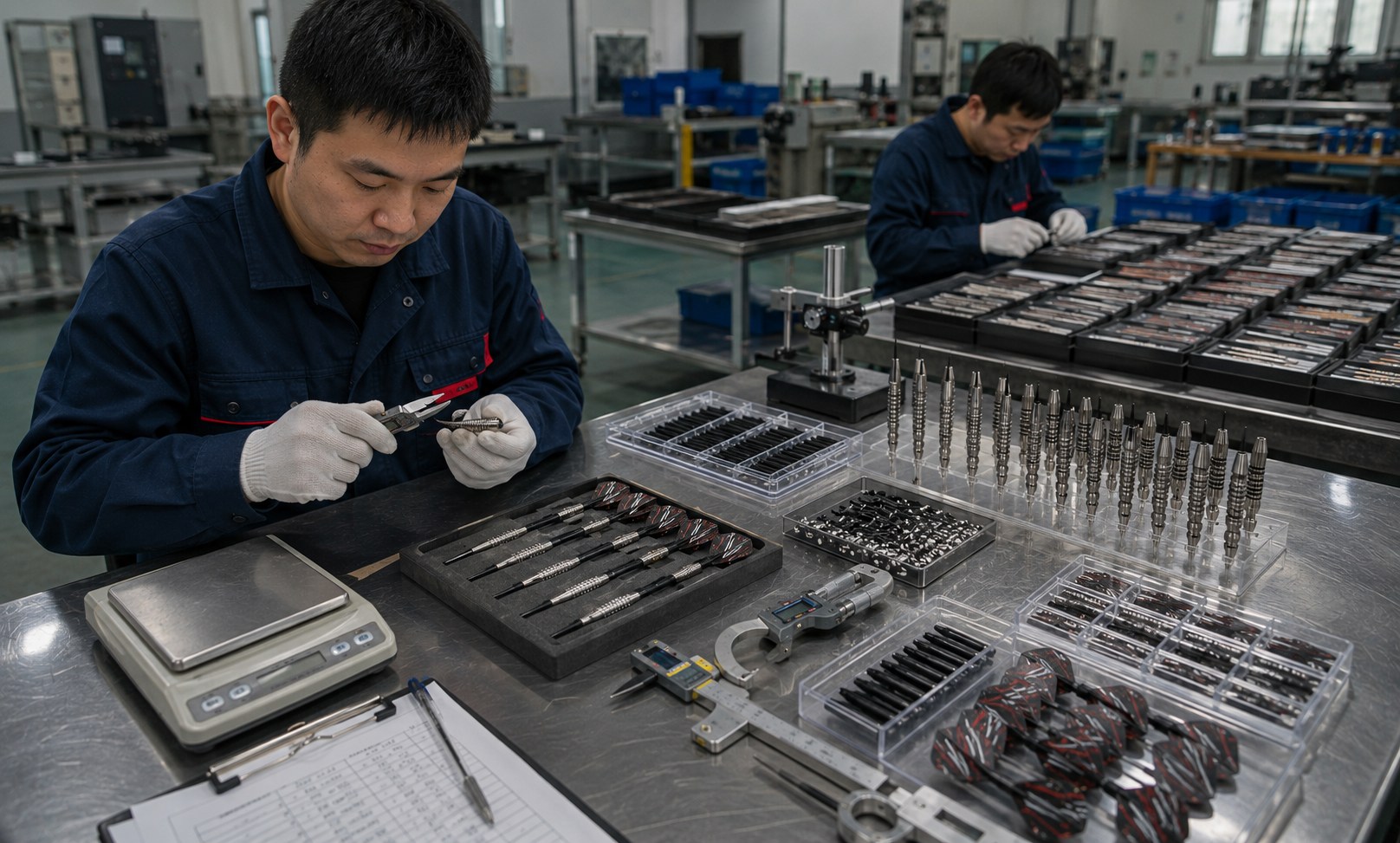
Raw tungsten material should be checked against the required material specification before machining begins.
In-Process Inspection
During production, critical dimensions can be checked to identify process deviations before large quantities are completed.
Finished Product Inspection
Completed barrels should be inspected for:
- weight;
- dimensions;
- machining defects;
- surface defects;
- coating problems;
- thread quality;
- logo accuracy;
- and assembly requirements.
Final Random Inspection
A final inspection can be used to verify that the finished shipment meets the approved specifications.
The important point is that quality control should not happen only at the end.
If a problem is discovered after thousands of pieces have been produced, correcting it becomes much more expensive.
An effective quality system attempts to detect problems as early in the production process as possible.
8. Can You Handle Complete OEM Packaging and Dart Set Assembly?
For many brands, OEM manufacturing does not stop at the barrel.
The final retail product may include a complete dart set consisting of:
- tungsten barrels;
- shafts;
- flights;
- points;
- spare accessories;
- dart cases;
- packaging;
- instruction cards;
- and branded components.
This means the manufacturer needs to coordinate multiple components.
Why Assembly Capability Matters
Imagine that your brand has designed a premium tungsten dart set.
The barrel is correct, but:
- the wrong flight artwork is installed;
- the shaft length is incorrect;
- the packaging uses the wrong language;
- the accessories are missing;
- or the retail box does not match the approved design.
The barrel itself may be perfect, but the finished product is still not ready for sale.
A manufacturer capable of handling complete OEM assembly can simplify the supply chain.
Instead of coordinating several different suppliers, the brand can potentially manage the product through one manufacturing partner.
Tungsten Dart Sets Can Be Customized
Depending on the project, OEM customization may include:
- barrel design;
- barrel finish;
- logo;
- flight artwork;
- shaft configuration;
- point configuration;
- packaging;
- retail box;
- and accessories.
This is particularly useful for brands launching a new collection and wanting consistent visual identity across the entire product.
9. What Is Your MOQ, Production Lead Time, and Reorder Process?
Price is important, but the purchasing decision should not be based on unit price alone.
You should understand the complete commercial structure.
Ask the manufacturer about:
- MOQ;
- sample lead time;
- production lead time;
- packaging lead time;
- shipping preparation;
- reorder requirements;
- tooling costs;
- and how repeat orders are handled.
MOQ Should Match Your Business Model
A new brand may not want to commit to a very large initial inventory.
At the same time, a manufacturer with an extremely low MOQ may not have the production structure required for larger-scale commercial orders.
The right MOQ depends on your business stage.
For example:
New product launch:
Smaller initial quantities can help validate market demand.
Established distributor:
Larger production runs may provide better unit economics.
Retail chain:
The manufacturer may need to demonstrate stable capacity and repeat-order capability.
Reorder Consistency Is Critical
The first production order is only the beginning.
A strong OEM relationship should allow the manufacturer to reproduce the approved product for future orders.
If you sell a successful 24 g tungsten dart today, your customers should be able to purchase essentially the same product months later.
That requires stable production records, specifications, tooling information, and quality standards.
10. Can You Provide Long-Term OEM Support for Product Development?
The final question is perhaps the most important:
Can this manufacturer support the product after the first order?
An OEM supplier should ideally be evaluated as a long-term production partner rather than simply as the company offering the lowest quotation.
A successful relationship may eventually involve:
- new barrel designs;
- additional weights;
- new grip patterns;
- different finishes;
- new packaging;
- tungsten dart sets;
- seasonal products;
- replacement components;
- and repeat production.
Product Development Requires Communication
Suppose your first tungsten dart collection performs well.
You may then want to develop:
- a 22 g version;
- a 24 g version;
- a 26 g version;
- a different grip profile;
- a premium black finish;
- or a new barrel design based on customer feedback.
If the manufacturer already understands your product specifications, brand requirements, packaging system, and quality expectations, developing the next product becomes significantly easier.
This is one of the biggest differences between a simple supplier relationship and a genuine OEM manufacturing partnership.
What Should You Look for in an OEM Tungsten Dart Manufacturer?
After asking these 10 questions, you should have a much clearer picture of whether a manufacturer is suitable for your project.
A reliable OEM tungsten dart manufacturer should be able to demonstrate more than product photos and a competitive quotation.
You should look for a combination of:
1. Material Knowledge
The manufacturer understands tungsten alloys, density, machining characteristics, and how material selection affects the finished barrel.
2. Engineering Capability
The factory can interpret technical drawings, review designs, develop prototypes, and identify manufacturing issues before mass production.
3. CNC Manufacturing Capability
The factory can consistently reproduce complex barrel geometries, grip patterns, dimensions, and machining details.
4. Quality Control
The manufacturer has defined inspection procedures covering materials, production, finished barrels, assembly, and final shipment.
5. Customization
The manufacturer can adapt barrel designs, finishes, branding, packaging, and complete dart-set configurations to the customer's requirements.
6. Production Stability
The factory can support both initial production and future repeat orders while maintaining consistent specifications.
7. Communication
The manufacturer communicates clearly about specifications, samples, production schedules, potential problems, and quality requirements.
OEM Tungsten Darts Should Be Evaluated Beyond the Price Per Set
When comparing different manufacturers, it is tempting to create a simple spreadsheet based on unit price.
For example:
| Manufacturer | Unit Price | MOQ | Lead Time |
|---|---|---|---|
| Supplier A | Low | 500 sets | 25 days |
| Supplier B | Medium | 1,000 sets | 30 days |
| Supplier C | Higher | 500 sets | 35 days |
But this comparison does not tell the entire story.
A better evaluation should also include:
- tungsten material specification;
- machining capability;
- dimensional tolerance;
- weight consistency;
- prototype quality;
- surface finish;
- QC process;
- packaging capability;
- communication;
- repeat-order consistency;
- and technical support.
A manufacturer that is slightly more expensive per set may ultimately be more economical if it produces fewer defects, reduces rework, maintains stable quality, and delivers consistently.
For premium products, manufacturing reliability is part of the product cost.
Questions to Ask During the First OEM Consultation
Before requesting a quotation, prepare as much product information as possible.
A professional RFQ can include:
Product Information
- Product type
- Target tungsten percentage
- Target weight
- Barrel length
- Barrel diameter
- Grip design
- Finish
- Color
- Logo requirements
Manufacturing Information
- Expected annual volume
- Initial order quantity
- Target launch date
- Packaging requirements
- Accessory requirements
- Quality standards
Commercial Information
- Target price range
- Destination market
- Required certifications, if applicable
- Shipping requirements
- Reorder expectations
The more clearly the product is defined, the more meaningful the manufacturer's quotation will be.
A vague request such as "Please quote 90% tungsten darts" does not provide enough information for a meaningful OEM comparison.
A detailed specification allows the manufacturer to estimate material consumption, machining time, finishing requirements, assembly, packaging, and production capacity more accurately.
How the Right Manufacturer Can Reduce OEM Project Risk
Choosing an OEM tungsten dart manufacturer is ultimately about managing risk.
There are several common risks during product development.
Design Risk
A design may look attractive digitally but be difficult to manufacture consistently.
Solution: conduct engineering review and prototype testing before mass production.
Quality Risk
Production batches may differ from the approved sample.
Solution: establish documented specifications, tolerances, and inspection standards.
Cost Risk
Unexpected machining or finishing requirements can increase production costs.
Solution: review manufacturability and production processes before finalizing the design.
Delivery Risk
Complex products can take longer to produce than expected.
Solution: establish a realistic production schedule that accounts for machining, finishing, assembly, packaging, and inspection.
Reorder Risk
The first order may be excellent, but future orders may not match it.
Solution: maintain approved samples, drawings, specifications, and production records.
Final Checklist: 10 Questions to Ask Before Choosing Your OEM Manufacturer
Before placing an OEM tungsten dart order, make sure you can answer all ten questions:
- What tungsten materials and alloys do you use?
- Can you manufacture custom barrel designs from engineering drawings?
- How do you control barrel weight and dimensional tolerances?
- What CNC machining capabilities do you have?
- How do you handle surface finishing and coating?
- Can you produce prototypes before mass production?
- What quality-control process do you use during mass production?
- Can you handle complete OEM packaging and dart-set assembly?
- What are your MOQ, production lead time, and reorder processes?
- Can you provide long-term OEM support for product development?
If a manufacturer can give clear, specific answers to these questions, you have a much stronger foundation for evaluating the partnership.
The goal is not simply to find a factory that can produce a tungsten dart.
The goal is to find a manufacturing partner that can turn your product concept into a repeatable, commercially reliable product while maintaining consistent quality across production batches.
Why OEM Buyers Should Evaluate the Whole Manufacturing Process
A premium tungsten dart is the result of multiple manufacturing stages working together.
The material must meet the required specification.
The CNC process must reproduce the intended geometry.
The grip pattern must be consistent.
The surface finish must match the approved standard.
The weight and dimensions must remain within the required tolerance.
Branding must be correctly applied.
Components must be assembled correctly.
Packaging must match the final approved artwork.
And the entire process must be repeatable when the next order arrives.
This is why selecting an OEM tungsten dart manufacturer should be treated as a manufacturing and product-development decision, not simply a purchasing decision.
The right partner can help you identify manufacturing problems before production, improve product specifications, control quality, and build a repeatable production system for future collections.
Frequently Asked Questions
1. What is an OEM tungsten dart manufacturer?
An OEM tungsten dart manufacturer produces tungsten dart products according to a customer's specifications, designs, branding, packaging, and product requirements. Depending on the factory's capabilities, OEM services can include product development, CNC barrel machining, finishing, logo application, component assembly, packaging, quality inspection, and repeat production.
For brands, OEM manufacturing allows the company to develop products under its own brand without building its own dart manufacturing facility.
2. What should I provide when requesting a custom tungsten dart quotation?
Ideally, provide the manufacturer with the target tungsten percentage, dart weight, barrel dimensions, technical drawings, grip requirements, finish, logo, packaging requirements, expected order quantity, and target delivery date.
If you do not have a finished engineering drawing, you can also provide sketches, reference products, dimensions, or design concepts. A technically capable manufacturer may then help convert the concept into a manufacturable design.
The more detailed the specification, the more accurate the quotation and production assessment will generally be.
3. What tungsten percentage should I choose for a premium dart?
The appropriate tungsten percentage depends on the product positioning, target weight, barrel dimensions, design requirements, and budget.
Higher tungsten content can allow a manufacturer to achieve a particular weight in a relatively compact barrel, but material percentage should not be evaluated independently from the actual product design.
For an OEM project, the better approach is to define the desired player experience and barrel dimensions first, then work with the manufacturer to determine an appropriate material specification.
4. How important is the prototype before mass production?
A prototype is extremely important for a custom tungsten dart project.
It allows the brand to evaluate the actual physical product rather than relying only on CAD drawings or digital renders.
During prototype approval, you can check the barrel dimensions, weight, grip feel, balance, machining quality, finish, logo placement, and compatibility with the intended components.
Prototype approval also creates a physical reference for mass production and can reduce misunderstandings between the buyer and manufacturer.
5. How can I compare two OEM tungsten dart manufacturers?
Do not compare manufacturers based only on price.
Evaluate their material specifications, CNC capabilities, prototype quality, weight and dimensional control, finishing processes, QC procedures, MOQ, lead time, packaging capabilities, communication, and ability to support repeat orders.
The best manufacturer for your project is not necessarily the factory offering the lowest unit price. It is the manufacturer that can consistently meet your required product specifications and support your commercial plans.
How We Helped a Dart Brand Refresh an Existing Product Without Rebuilding the Entire Collection
Why Product Version Control Matters for Private Label Dart Brands
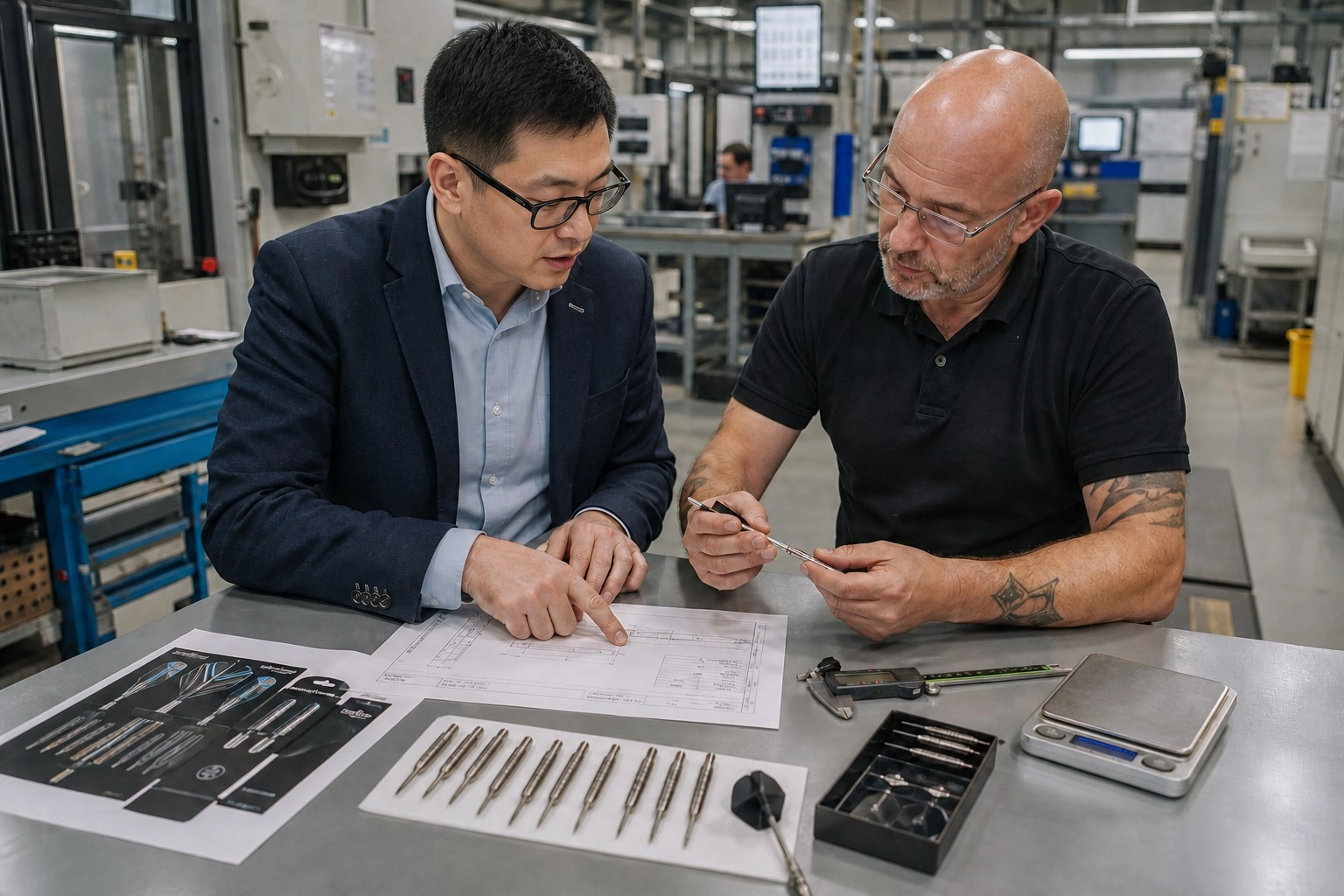
How We Supported a Retail Customer Through a Dart Product Specification Change
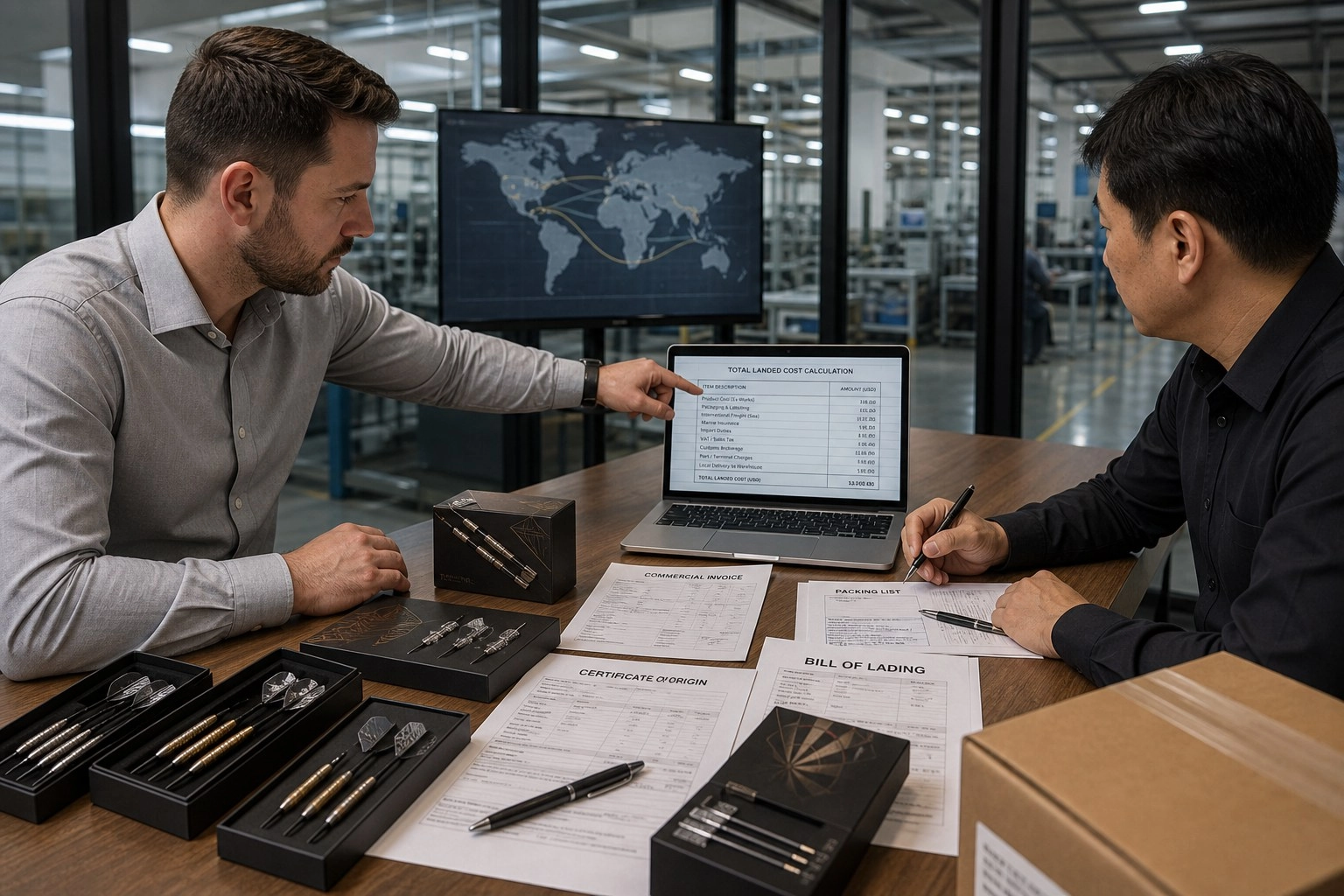
How to Calculate the Landed Cost of Imported Dart Products
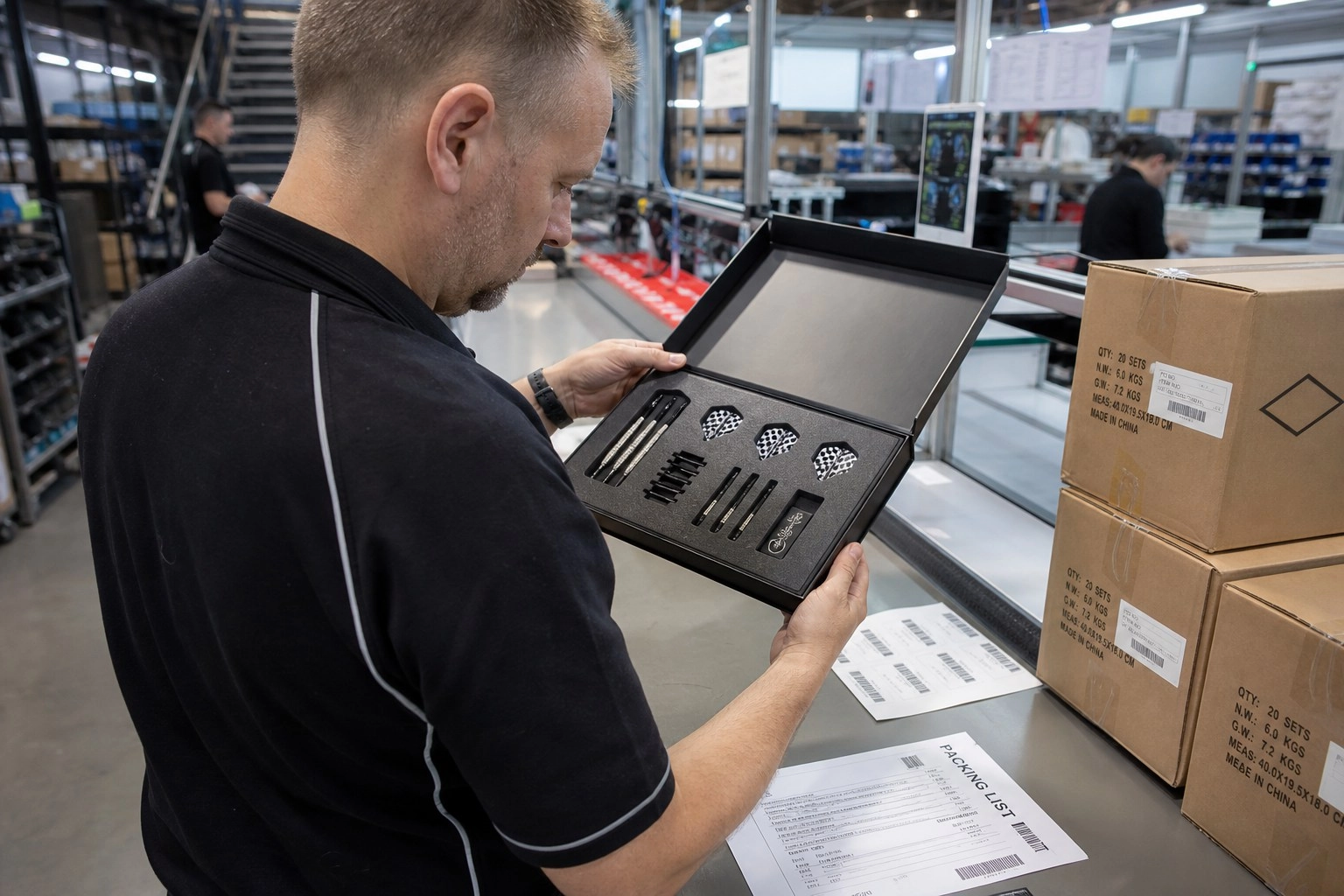
How We Helped an Online Dart Retailer Reduce Product Damage During International Shipping
Dartboard surrounds
Does the guard material support personalized color customization?
Yes, customers can choose a variety of colors, and can also add brand logos or patterns.
Dart boards
What is the processing accuracy of the dart rod?
We use CNC precision machining, and the tolerance is controlled within ±0.01mm to ensure consistency.
Customized service
What is the minimum order quantity for customized services?
The minimum order quantity varies depending on the product type, usually 500-1000 pieces.
What dart accessories can be customized?
Dart shafts, dart blades, dart bags, guards and dart cabinets can be customized.
Dart flights
Is the pattern printing of the dart blade durable?
Thermal transfer or UV printing technology is used to ensure that the pattern is durable and does not fade.

AI Dart Camera Scoring System With LED Dartboard Lights Automatic Electronic Dart Scoring Kit Smart Dart Auto Scorer
Our Smart Dart Scoring System transforms a traditional steel-tip dartboard into a smarter, connected playing experience. With automatic score recognition, real-time tracking, and performance data, it eliminates manual scorekeeping and helps players focus on playing and improving. Ideal for home entertainment, training, pubs, bars, and dart clubs, it offers an easy way to bring smart scoring to your existing dart setup.
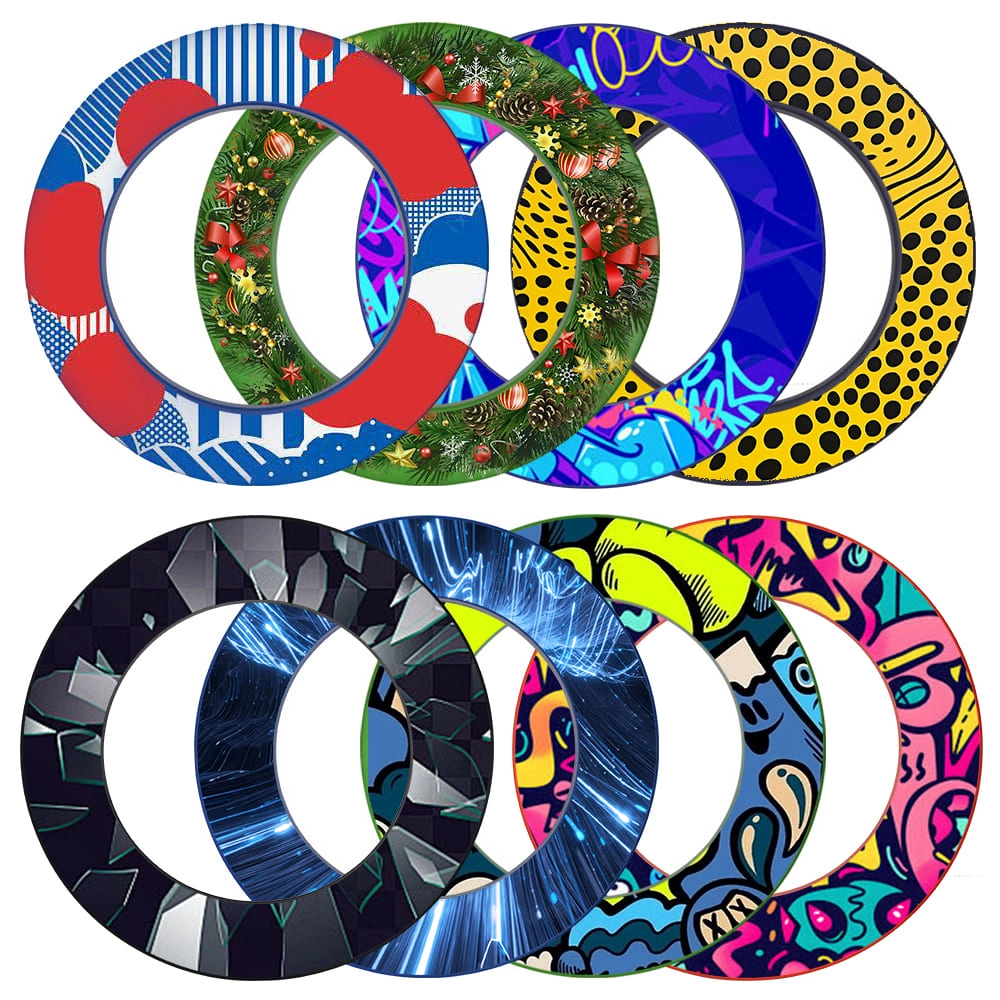
Wholesale custom pattern PU dartboard surround
PU dartboard surround is a dart board accessory made of high-strength polyurethane material, providing all-round protection to prevent darts from damaging walls or furniture and extend the service life of the dart board.

2BA Darts Flight Wholesale EVA Standard Shape OEM/ODM for Darts Retailers & Distributors
2BA Darts Flight designed for standard 2BA dart barrels. Made from durable PET material – tear-resistant, stable flight trajectory, and long-lasting performance. Custom color, logo & packaging accepted (OEM/ODM). Factory direct wholesale pricing. Ideal for darts retailers, sporting goods distributors & e-commerce resellers worldwide

EPU Dartboard Surround Bulk Order Available, OEM/ODM for Retailers & Distributors
EPU Dartboard Surround made from food-grade, eco-friendly EVA foam – biodegradable, odor-free & safe for home and commercial use. Fits standard 18" dartboards. Easy tool-free installation. Protects walls, absorbs dart impact. OEM/ODM available – custom color, logo & packaging accepted. Factory direct wholesale pricing. MOQ 50 pcs. Ideal for retailers, distributors & sporting goods importers.
Discover SKIPJACK’s Custom Dart Solutions
SKIPJACK offers darts custom-made solutions designed for excellence. Improve your game with our precision-crafted, customized darts.

At SKIPJACK, We offer darts customized solutions tailored to meet the unique needs of our clients through our ODM (Original Design Manufacturing) and OEM (Original Equipment Manufacturing) services.


Whatsapp: +8615919340906
SKIPJACK DARTS
SKIPJACK DARTS
SKIPJACK DARTS